
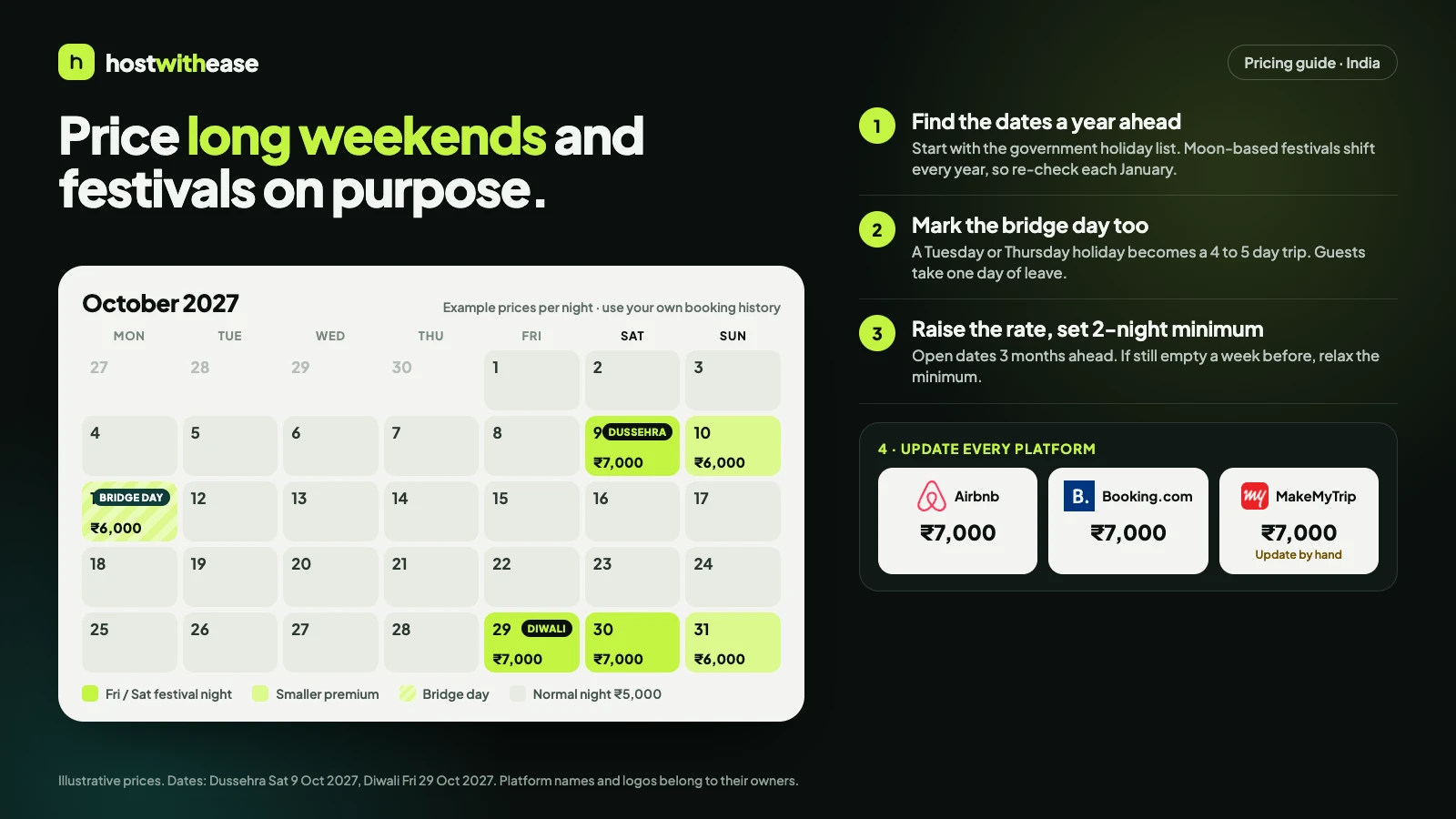
In India, demand does not rise evenly through the year. It jumps when office workers see a holiday next to a weekend. If your nightly rate is the same on a normal Tuesday and on the Friday before a long weekend, you are likely leaving money on the table, or sitting empty because you priced too high too late.
This guide shows how to find the dates that matter, how to price them, and what to do about minimum stays. It is written for hosts of homes, villas and apartments, especially in weekend-getaway areas near big cities.
Find the dates first
Start with the central government's list of gazetted holidays, which the Department of Personnel and Training publishes each year. States, banks and schools add their own days, so also check your state's list.
Looking at the 2027 lists published by sites such as timeanddate.com and calendarglobe.com, a few stand out:
- Republic Day, Tuesday 26 January. Many people will take Monday 25th off for a four-day break.
- Good Friday, 26 March, which makes a three-day weekend (Holi falls on Tuesday 23 March).
- Dussehra, Saturday 9 October, with Monday 11th as a natural bridge day.
- Diwali, Friday 29 October. Lakshmi Puja on a Friday makes a ready-made long weekend.
Moon-sighted holidays such as Eid can move by a day, and lists mark them as tentative. Treat those dates as soft until they are confirmed, and do not block or price them rigidly.
Do not forget the "bridge" days
A holiday on Tuesday or Thursday often creates a four-day or five-day trip, because guests take one day of leave. These dates book fast and often at a longer stay than a regular weekend. Mark the bridge day, not just the holiday.
How much to raise the rate
There is no honest universal number. Instead, use your own data:
- Look at what you charged and earned for the same dates last year, if you have it.
- Compare how fast those nights filled. If a date was booked 6 weeks ahead, you priced too low. If it stayed empty until the last week, you priced too high.
- Check three or four similar listings near you on those dates. See what they charge and whether they are still available.
- Start higher, then step down. It is easier to cut a price 10 days out than to raise it after a guest has booked.
A common pattern is a premium on the Friday and Saturday nights and a smaller premium on the bridge nights. Keep the increase to what nearby comparable homes are actually getting.
Set minimum nights on purpose
On a long weekend, a one-night guest can block the nights around them. A 2 or 3 night minimum protects the full stretch. But if the dates are still open a week before, relax the rule so you do not lose a booking entirely. Our guide on gap nights covers that trade-off.
Open dates early, and tell past guests
Guests planning around a holiday look 4 to 8 weeks ahead, sometimes more for Diwali. If your calendar for those dates is closed or not updated, they book elsewhere. Open the dates at least 3 months ahead, then message previous guests on WhatsApp, with their consent, that the dates are open. A short, polite message works best.
Wedding season and local events
In many regions, wedding season brings families who need several nights and several rooms. IPL match days, music festivals and local temple fairs can also fill a town. These dates differ by city, so ask the local tourism office, search the event page, or note when your nearby hotels are sold out. We have not found a single reliable national calendar for these, so verify locally.
Watch out for these mistakes
- Pricing once and forgetting. Review festival dates every month as they approach.
- Forgetting all platforms. If you raise rates on Airbnb but not on Booking.com or MakeMyTrip, the cheaper listing gets the booking. MakeMyTrip needs to be updated by hand unless you use an approved channel manager.
- Ignoring cleaning capacity. Everyone checks out on the same day. Confirm your cleaner is available for holiday turnovers.
- Ignoring taxes. Higher rates can change your GST position. Check with a chartered accountant.
Keeping the calendar honest
Higher festival prices only pay off if the calendar is right. HostWithEase pulls your Airbnb and Booking.com calendar links every 10 minutes, shows every booking in one place, and flags a listing with an empty week ahead, so you notice a slow festival week while there is still time to adjust. MakeMyTrip is not auto-synced, so those bookings are added by hand. There is a 14-day free trial at hostwithease.in.
Frequently asked questions
How far ahead should I open dates for Diwali?
Three months is a safe starting point. Check how early guests booked last year and open earlier if they booked early.
Should I raise prices for every public holiday?
No. Only raise for holidays that join a weekend or create a bridge. A mid-week holiday with no link to the weekend often changes little.
Are festival dates the same every year?
No. Many follow the lunar calendar, so they move. Check the official holiday list each January and treat moon-sighted dates as tentative.
Do I need to charge GST?
It depends on your rates and your registration status. This is a question for a chartered accountant, not something to guess.
Comments
Sign in to comment.
- No comments yet.